V. Martinez Ybor & Co.
Ybor City
As stated in the dissertation by L. Glenn Westfall dated December, 1977 titled Don Vicente Martinez Ybor, the Man and His Empire: Development of the Clear Havana Industry in Cuba and Florida in the Nineteenth Century, Vicente Martinez Ybor (1818-1896) was a Spanish immigrant from Valencia who in 1832 emigrated to Cuba where during the first three years after arrival he worked as a clerk in a storeroom and then became a broker in the cigar business. In 1848 he married Palmira Learas ( -1862) with whom he had four children; Eduardo Martinez Ybor-Learas, Candido Martinez Ybor-Learas, Eloise Martinez Ybor-Learas and Antonia Martinez Ybor-Learas. While a broker selling cigars for other manufacturers, Martinez Ybor ran a small shop using his own employees and convict labor to produce cigars under the Principe de Gales brand. In 1852 to cope with the increased demand, Martinez Ybor decided to expand the small shop and opened his own factory in Havana which was an immediate success. After his wife Palmira died in 1862, in 1866 Martinez Ybor married a second time to Mercedes Revillas (1842-1931) from which marriage six children were born. Mercedes $100,000 dowry contributed to the marriage was critical in the development of Martinez Ybor’s business.
In 1866 the Spanish government instituted a number measures that hurt business, including 6% taxes on income and up to 12% for administrative purposes. Although Martinez Ybor was loyal to the Spanish Crown, the government’s new taxes and attitude towards business made him doubt his support to Spain so he decided to financially help the separatist movement that sought political independence and economic freedom. When the 10 Year's War began, an order for his arrest was issued for assisting the separatists who favored freedom from Spain, so in 1868 Martinez Ybor had to leave most of his wealth behind and flee Cuba for Key West before the military would arrest him.
As was the case with Martinez Ybor, the 10 Year's War in Cuba prompted many workers to emigrate to Key West where at the time the Cuban population was relatively small. However, in a short period of time the Cuban population grew considerably and the new immigrants made Key West a boom town. With the savings he was able to bring with him, Martinez Ybor rented som space on Whitehead St. near the docks and hired cuban emigres who began producing the high quality Principe de Gales Clear Havana cigar with Cuban tobacco imported from plantations in the Vuelta Abajo region, secured by his son-in-law Ignacio Castañeda who had remained in Cuba. In 1872 he organized V. Martinez Ybor & Co. with his son Eduardo ( -1892) and Eduardo Manrara (1845- ) as partners.
Westfall also states that in 1874 Martinez Ybor sold his Key West factory and opened an office in New York City. He contracted with other manufacturers in Key West to produce the El Principe de Gales cigars while he was building a new factory in New York he named El Coloso at the corner of Rivington St. & Attorney St. in Lower Manhattan. The NY factory opened in 1876 with space for over five hundred cigar workers producing Coloso and Mercurio brand cigars. However, by 1878 Martinez Ybor decided to return to Key West due to the organization of labor unions and labor strikes in New York and the El Coloso factory was eventually closed. The end of the Ten Year’s War allowed Martinez Ybor to return to Cuba, so in 1878 he established Van Ramdohr & Martinez Ybor, a tobacco leaf distributorship in New York with his son-in-law in Havana as a buyer. This business lasted until 1884.
The years following his return to key West were prosperous years for Martinez Ybor and the Key West cigar industry. During those years Martinez Ybor invested some $100,000 in his factory which was managed by his partner Eduardo Manrara. In 1885 there were five hundred five workers at the Key West factory earning total wages of $200,000. But despite that prosperity, on August 5, 1885 a strike began that lasted until September 2nd which prompted Martinez Ybor to look to Galveston, Pensacola and Mobile to relocate and establish an industrial town where labor conflicts would be minimized.
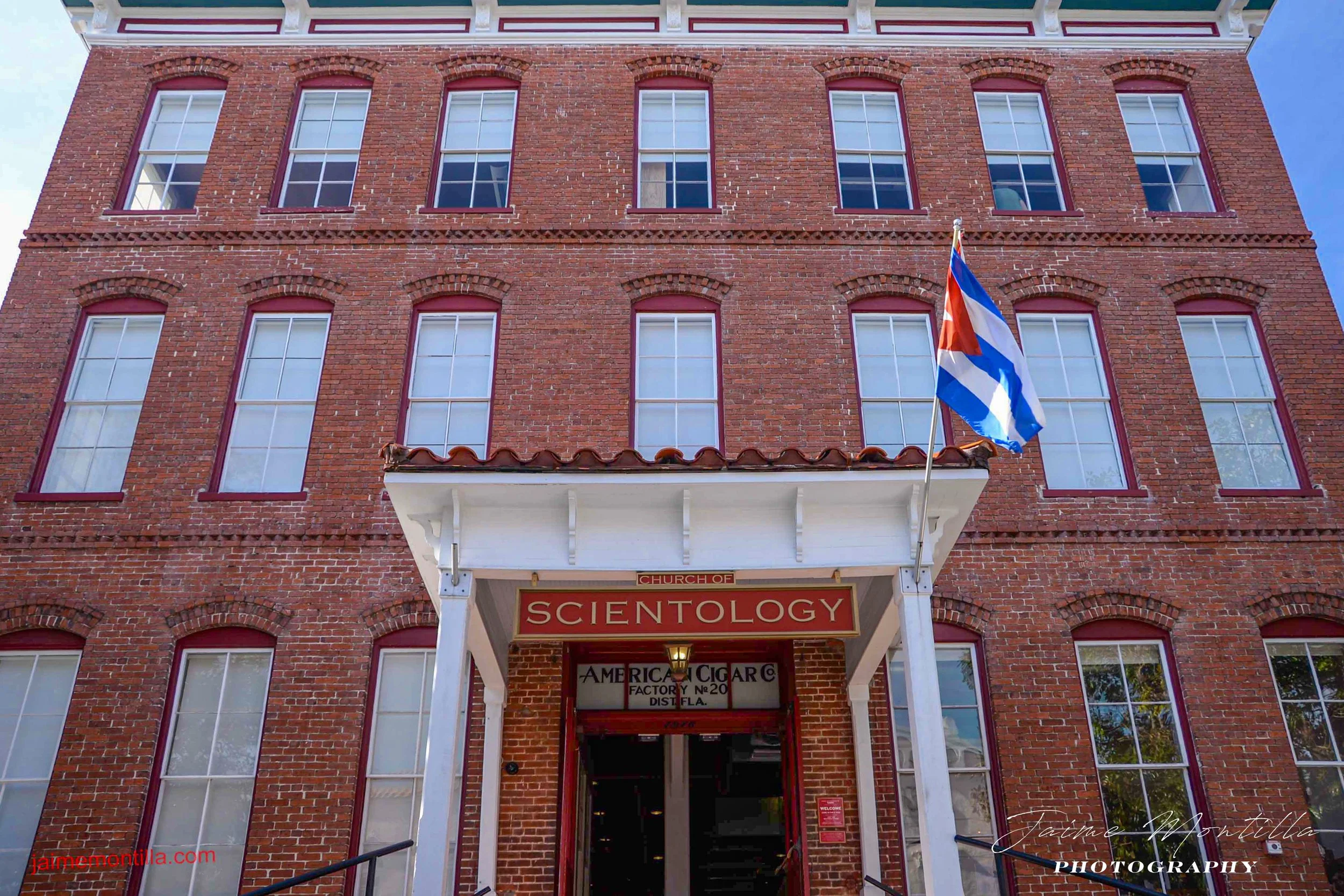
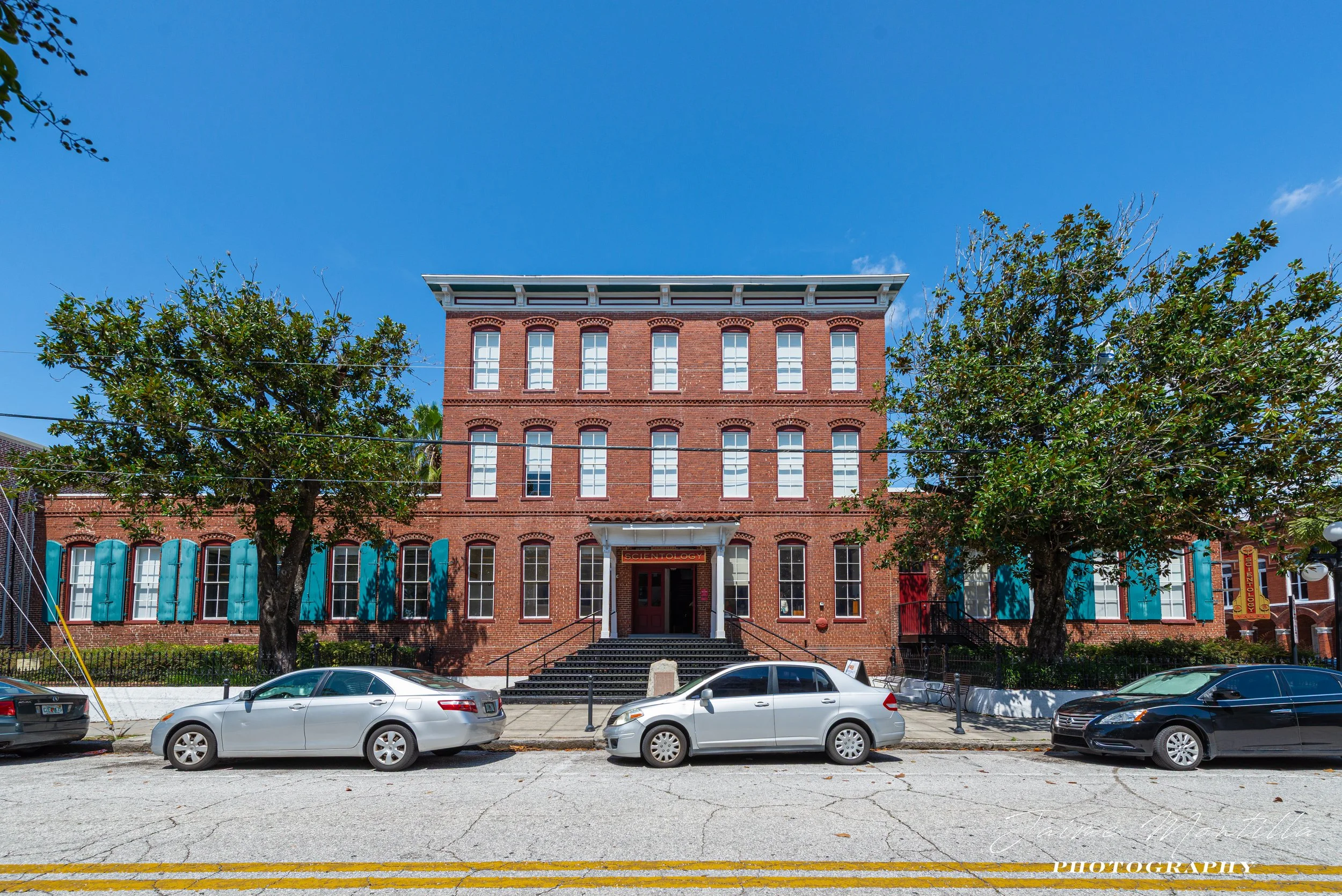
As stated in the Tampa Cigar Industry page, in 1885 Martinez Ybor learned about the possibilities in Tampa from Gavino Gutierrez and Bernardino Gargol. As a result of Gutierrez and Gargol visit with Martinez Ybor in Key West, he went to see the area, met with city officials and members of the recently created Tampa Board of Trade who did not hesitate to offer incentives that prompted Martinez Ybor to open a factory there. Construction of The V. Martinez Ybor & Co. Factory Building designed by C. E, Parcell began on October 5, 1885 and finished in 1886. On April 1, 1886 a fire destroyed several factories in Key West including El Prince de Gales factory, this incident hurried Martinez Ybor total relocation of his Key West operations to Tampa. At the time of its inauguration, it was the largest cigar factory building in the world and is to this day the oldest remaining cigar factory building in Tampa. It was supposed to be the first cigar factory in Tampa but Martinez Ybor could not beat Sanchez & Haya in becoming the first production cigar factory in town by two months. Sanchez & Haya opened for business on April 1, 1886 while V. Martinez Ybor & Co. did not open until June 13, 1886 because Cuban workers refused to work for a Spaniard Martinez Ybor had hired as bookkeeper.
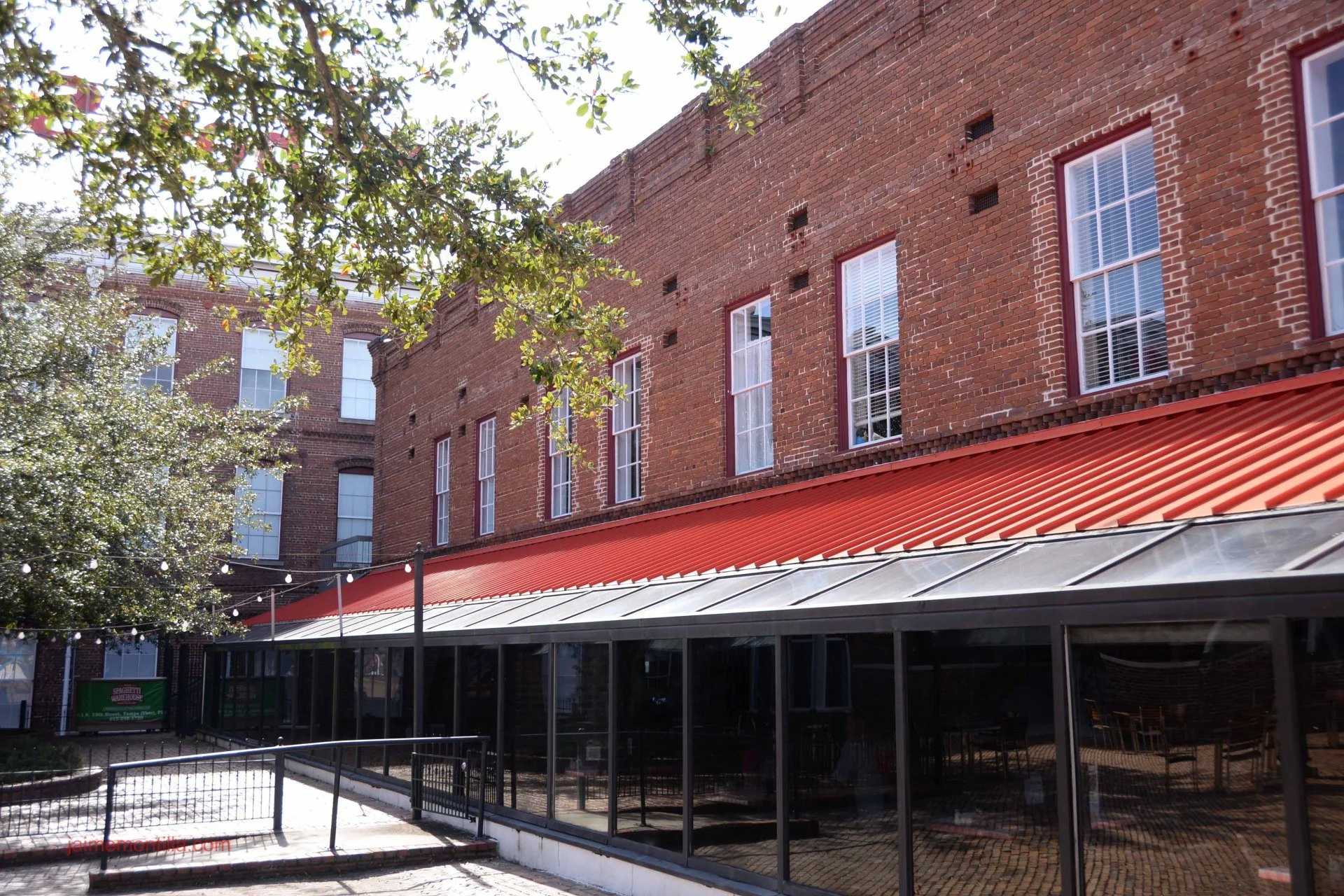
This building is located at the corner of Republica de Cuba St. & 9th Ave., fronting Republica de Cuba St. Originally, it consisted of a three story main nave. In 1892 a one-story packing room addition was attached to the north of the original structure along 9th Ave. When Julius Ellinger decided to move from West Tampa to Ybor City, the packing room area was leased to the Julius Ellinger Co. After Ellinger's death on May 17, 1902, the Julius Ellinger Co. merged with then renamed Ybor-Manrara Co. becoming part of The Havana-American Co.
In 1895 a small one-story brick office extension was attached to the left/south of the main nave. In 1902 an additional three story structure was added on the corner of 13th St. & 8th Ave. known as the Havana American Stemmery because it was there the stems would be separated from the tobacco leaves. This addition was leased from ca. 1915 to 1932 to the M. Stachelberg & Co. The last structure added to the complex was the 1903 brick bonded warehouse building on the corner of 13th St. & 9th Ave. This structure was previously the Manuel Chavez cigar factory building identified as such in the 1899 Sanborn Fire Insurance map of June 1899. The three buildings that practically occupied the whole city block, totaled 77,622 sq. ft. and had a common courtyard between them.
The V. Martinez Ybor & Co. factory produced the following brands: La Sagasta, Rosa de Junio, Flor de Madrid, Mi Perla, Bianca, La Perla, Castenera, Abundancia, El Triunfo, La Sublima, Panderetta, Amorosa, Messina, Flor de Roby, La Selegna, La Palladina, La Mulysa, La Tenitas, Monona, Estancia, Cetina, Urbino, Anavah, El Abrazo, Madrileña, Telitah, Los Imortalles, Tasmania, La Chanita and La Genoa. Its flagship product was of course the Principe de Gales cigar, which quality and acceptance is very well described in this 1906 article in The Theater Magazine.
After his death in 1896, principal ownership of V. Martinez Ybor & Co. passed on to Eduardo Manrara, Martinez Ybor longtime friend and business associate who was willed 75% ownership. V. Martinez Ybor & Co. then changed its name to Ybor-Manrara Co. In 1899 Ybor-Manrara Co. consolidated with Seidenberg & Co. and other cigar companies to form The Havana-American Co. In 1901 The Havana-American Cigar Co. was acquired by the American Cigar Co. a branch of American Tobacco Co. also known as The Cigar Trust, headed by James Buchanan Duke.
On June 12, 1901 V. Martinez Ybor Sons Co. was incorporated under the laws of Florida. According to this article in the March 7, 1902 Tobacco publication, V. Martinez Ybor Sons Co. was established at a factory on 16th St. & 15th Ave. The company was established by Vicente Martinez Ybor sons Salvador Vicente Martinez Ybor-Revillas as President and Rafael Martinez Ybor-Revillas as Vice President, A. Ramirez as Secretary/Treasurer and Manuel Chavez as Superintendent. Chavez and Ramirez both had years experience at Ybor-Manrara Co.
In 1954 Hav-A-Tampa purchased the V. Martinez Ybor Cigar factory building and manufactured cigars there until 1961, then used it as a warehouse until 1972. They sold the building to Trend Publications in 1972. On July 31, 1980 Ybor Squate LTD acquired ownership of the factory building and made it into a small shopping mall. On May 12, 2010, the Church of Scientology bought the factory building and currently uses it as administrative space and as a place of assembly. Besides the Church, the the Stemmery building used to be known as Ybor Square and the old warehouse building houses the offices of Creative Loafing and used to house The Spaghetti Warehouse which closed in 2020.
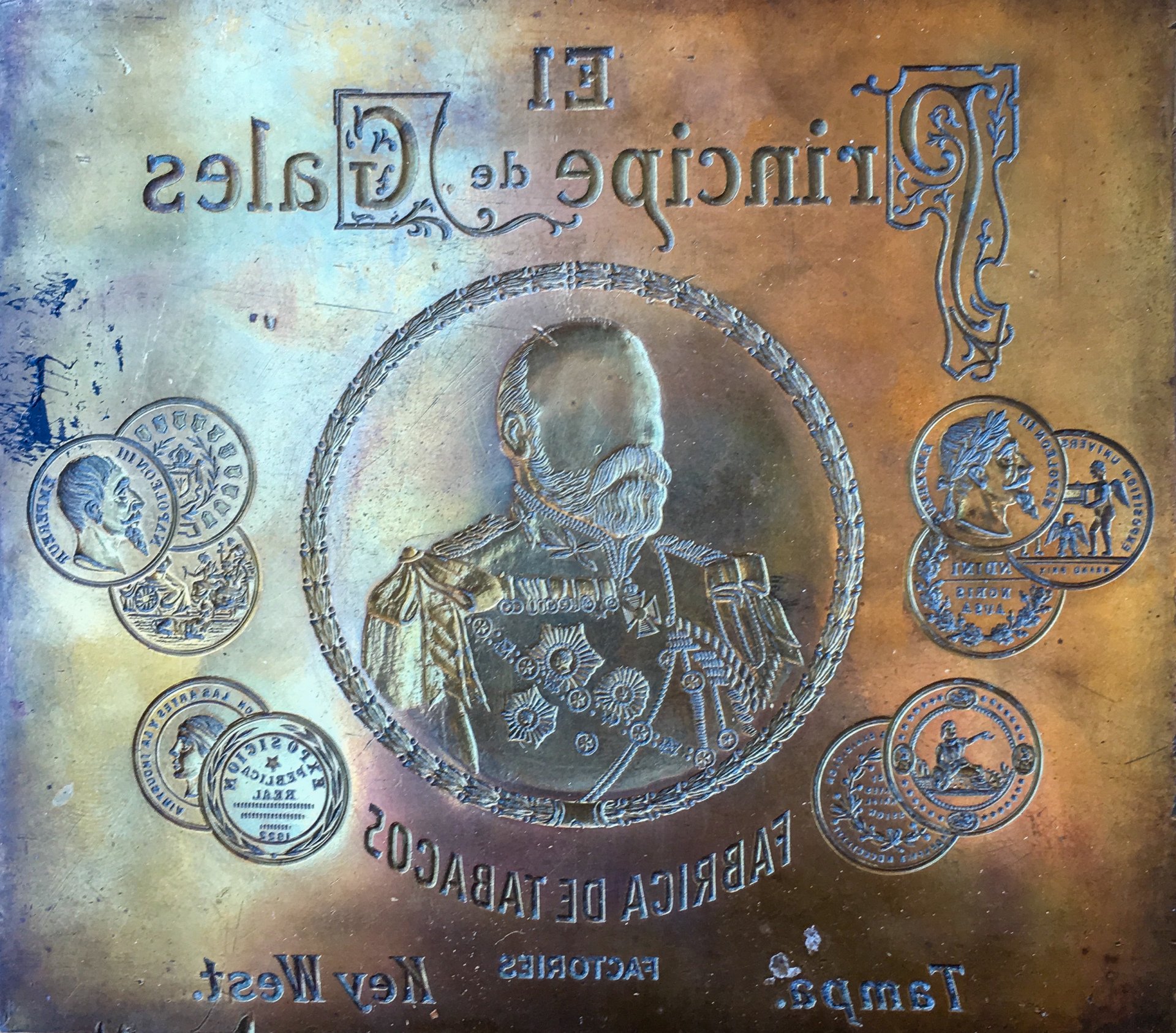
While taking pictures of the outside, a security guard from the Church of Scientology approached me and was kind enough to allow me to take pictures of the interior and some of the old equipment still on the premises, their generosity is greatly appreciated. The Principe de Gales cigar box and label printing plate are made available by Robert Cerkleski from his private collection.



December 2014

December 2014
July 2018
July 2018




Historical Tin Ceiling ca. 1890

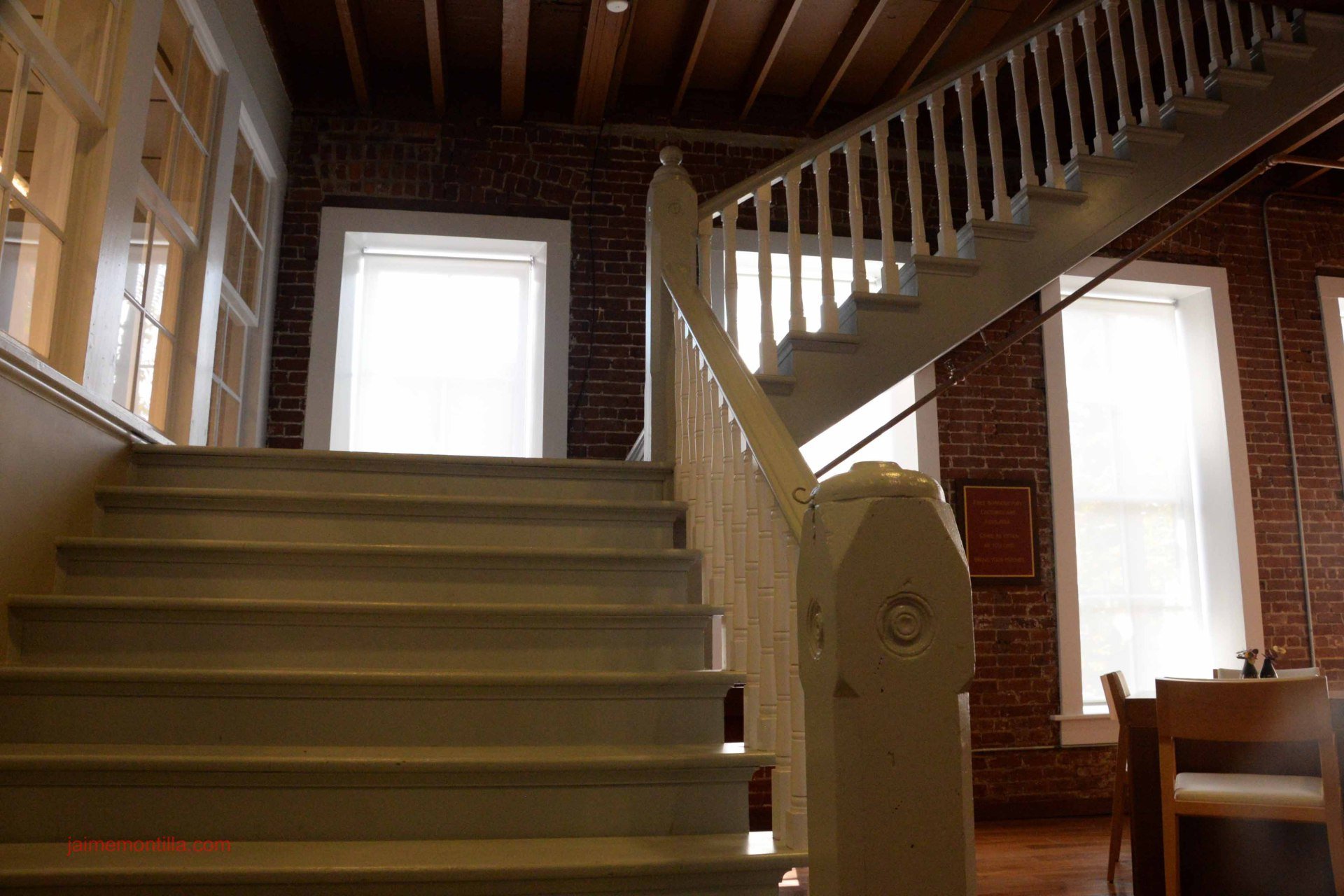
Staircase to 2nd floor ca. 1886


Packaging and labeling table


Tobacco supply bin ca. 1886

Tobacco supply bin ca. 1886


Tobacco bale press ca 1886