Appleton Estate
Appleton Estate is the oldest sugar estate and distillery in Jamaica. Its origin dates back to 1655 when the English Crown granted land to the heirs of Francis Dickinson (1632-1704) for his service in the Invasion of Jamaica in1655. It is believed it was the year 1749 when rum was first produced from sugarcane grown in the estate making Appleton Rum the world's second oldest spirit behind Mount Gay Rum from Barbados. The Dickinson family sold the estate in 1845 and subsequent owners continued producing rum and acquiring additional land for the estate.
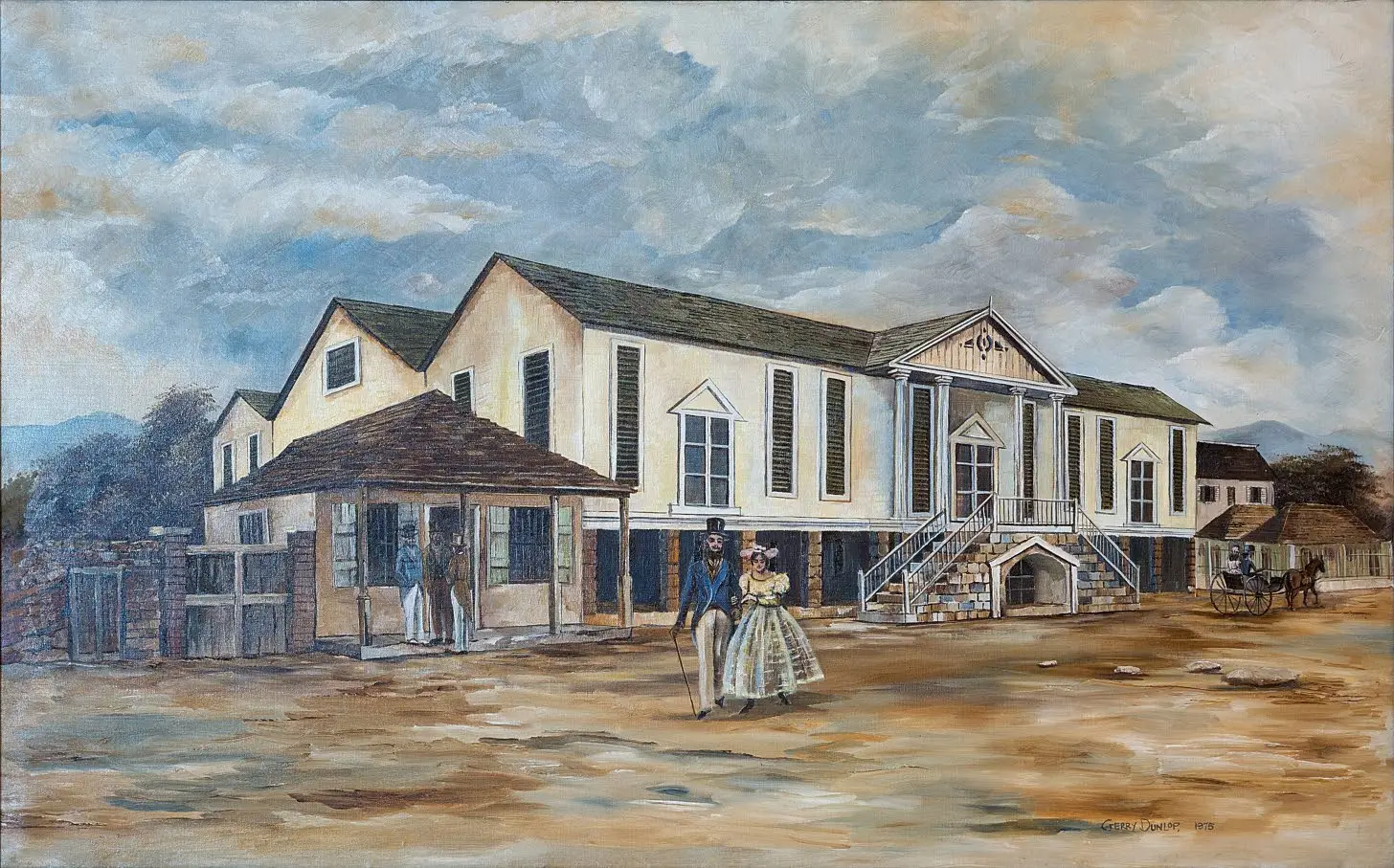
John Wray ( -1870), a carpenter by trade from St. Ann Parrish, came to Kingston seeking opportunities in a city that at the time was drawing men and women from all across the island. The city had a reputation for rowdiness and excess from its Port Royal buccaneers and privateers days, but in the 1820s was striving for respectability and growth. The construction of the Kingston Theater (depicted in the painting below) signaled an ambition to bring European sophistication and cultural refinement to Jamaica’s shores. Wray recognized a growing need in the heart of the city and in 1825 opened the Shakespeare Tavern strategically situated next to the theatre. The tavern quickly became a gathering place for merchants, sailors, newly emancipated citizens and the city’s tradesmen, a melting pot emblematic of Kingston’s changing face. Here, Wray began experimenting with local rum blends to meet the ever growing demand.
Just before retiring in 1862, in 1860 Wray brought his nephew Charles J. Ward (1838-1913) into the business and made him a partner giving rise to the name J. Wray & Nephew, the oldest registered company in Jamaica. Ward relocated the business to Port Royal St, closer to Kingston’s vital docks, capitalizing on bustling trade and maritime traffic. Under Ward, the company grew rapidly, operating around thirty rum shops across Kingston and building a reputation that extended beyond the city’s boundaries. Charles J. Ward not only took over the business at the death of his uncle in 1870, but expanded it further into rum trading and production. Ward's rum won medals in the 1862 London International Exhibition and subsequent exhibitions in Paris (1878), Amsterdam (1883), New Orleans (1885) and Jamaica (1891).
Before Ward's death, J. Wray & Nephew had acquired three sugar estates including Monymusk and distribution rights for other brands. After Ward's death, in 1916 the trustees who administered his estate sold the company to Cecil Verner Lindo’s (1870 - 1960) Lindo Brothers & Co. Ltd. which he had established in 1914, and a new company J. Wray & Nephew Co., Ltd. was formed. Shortly thereafter, J. Wray & Nephew Co. Ltd. acquired the Appleton Estate and in 1917 moved all distillery operations there. J. Wray & Nephew Co. Ltd. continued to operate under the management of Lindo Brothers & Co. Ltd. until 1939 when they sold it to Cecil Vernon’s brother Percy Lindo (1877-1946). In 1957 the heirs of Percy Lindo sold the company to a syndicate composed of Lascelles deMercado & Co. (33.3%), Henriquez Bros. Ltd (33.3%) and Sir Harold Mitchell (33.3%). In 1989, Lascelles deMercado & Co. acquired all shares held by the other syndicate members making J. Wray & Nephew Co. Ltd. a wholly owned subsidiary. In 2008, J. Wray & Nephew Co. Ltd. was bought by the Trinidad company CL Financial Ltd who in September 2012 sold its 81.4% stake in Lascelles deMercado & Co. to the Gruppo Campari for $414.8 million. Following is a quote from the article published in the Caribbean Journal edition of September 3, 2012 notifying the sale:
“Italian spirits company Gruppo Campari has signed an agreement to acquire a controlling stake in spirits company Lascelles deMercado & Co., Ltd, the company announced in a release Monday. Lascelles deMercado is based in Kingston, Jamaica. Its portfolio includes the Appleton Estate, Appleton Special/White, Wray & Nephew and Coruba brands. The 81.4 percent stake came at a total cost of $414.8 million on a cash-free/debt-free basis. It is the third-largest acquisition in Campari’s history, following its purchases of the Wild Turkey and Skyy Spirits brands. The acquisition will be made through a formal tender to LdM’s board. “With Lascelles de Mercado, the award-winning distiller of world-class premium dark, overproof and gold Jamaican rums, we are once again leveraging our acquisition framework in a very disciplined and consistent manner for future growth,” said Bob Kunze-Concewitz, CEO at Campari. The company said the purchase would help develop a “critical mass” in markets such as the US, Canada, Mexico and Jamaica. “The addition of Appleton, Wray & Nephew and Coruba rum brands as well as a portfolio of local Jamaican brands will help us build our critical mass further in key North American markets, provide a leading market position in Jamaica, a major destination in the Caribbean, whilst laying the foundations for future international growth across all major usage occasions of the growing and premiumising [sic] rum category,” he said.”
Sugarcane production at Appleton for the 2016-2017 & 2017-2018 crop years were 18,900 &16,500 m.t., or 22% & 20% of the total island production of 88,000 & 82,400 m.t. Most of the production at Appleton Sugar Factory was molasses used in the making of rum. In July 2020, J. Wray & Nephew Co. Ltd. confirmed that it would cease to operate its Appleton Estates Sugar Factory. Chairman of J. Wray & Nephew Co. Ltd. Clement Jimmy Lawrence, said that despite the closure of the sugar factory, Appleton Estate Distillery and the Joy Spence Appleton Estate Rum Experience would continue normal operations.